
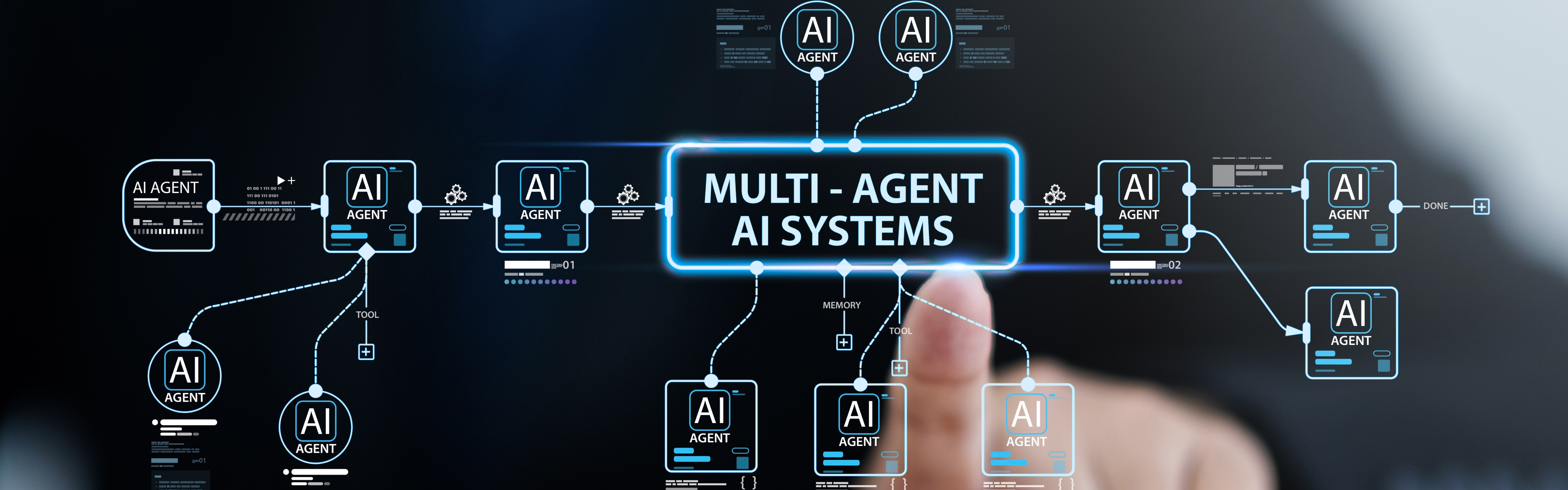
Why Are Multi-Agent Systems Becoming Important in Enterprise AI Architectures?
Artificial intelligence investments have now gone beyond systems that merely produce content or answer questions. Today, enterprises are turning toward more advanced artificial intelligence solutions that can analyze data, manage processes, interact with different systems, and take action in line with specific goals.
At the center of this transformation lie agent-based architectures. In particular, the Multi-Agent Systems (MAS) approach, which enables multiple AI agents to work in coordination, stands out as an important architectural alternative in managing complex enterprise operations.
Unlike structures where a single model attempts to manage all processes, the Multi-Agent Systems approach ensures that tasks are distributed among specialized agents. Thus, stronger solutions can be developed in terms of scalability, flexibility, and operational agility.
What is Multi-Agent Systems?
Multi-Agent Systems (MAS) is a software architecture in which multiple artificial intelligence agents work in coordination to achieve a specific business goal. In this architecture, each agent specializes in specific tasks and, while fulfilling operations within its own domain of responsibility, can share information or collaborate with other agents when necessary.
In enterprise applications, agents can assume different roles. While one agent analyzes a user request, another agent can query enterprise knowledge sources, another can evaluate compliance with business rules, and yet another agent can report the results obtained. Thanks to this division of tasks, complex processes become more manageable.
The important point is not that agents act completely independently. In modern Multi-Agent architectures, planning tasks, distributing them to agents, and combining results are often managed by an orchestration layer. Thus, which agent will undertake which task, which data it can access, and which tools it can use throughout the process can be controlled centrally.
This approach can be considered the digital adaptation of the specialization model that organizations have applied in human teams for years. Just as teams with different expertise work together toward a common goal, AI agents can also create more efficient and sustainable solutions by taking on roles within their own competency areas.
Why Are Enterprise AI Architectures Changing?
Digital ecosystems of organizations are becoming more complex day by day. While different departments work with different applications, data sources, and business rules; decision-making processes increasingly rely on more data, integration, and automation.
This change also transforms expectations from artificial intelligence projects. While in the past it was considered sufficient for a single model to perform specific tasks, today organizations demand solutions that can support interconnected processes end-to-end, integrate with different systems, and adapt to changing needs.
For this reason, artificial intelligence architectures are also evolving from monolithic structures to more modular structures. Instead of having every task managed by the same AI system, having agents with specific expertise work in coordination facilitates maintenance processes and ensures faster responses to new business needs.
In addition, regulations, data security, and governance requirements are among the important reasons for this transformation. Because which agent can access which data, what decisions it can make, and what actions it can perform can be defined more clearly, organizations can manage AI solutions in a more controlled manner.
As a result, what is changing is not only the AI models used; it is how these models are organized and managed within enterprise processes.
What Advantages Do Multi-Agent Systems Offer to Enterprises?
As enterprise needs diversify, managing business processes in a flexible and sustainable manner becomes more critical. Multi-Agent Systems offer significant advantages to organizations in many areas, from scalability to operational resilience, by ensuring that tasks are distributed among expert agents.
1. Scalability
As enterprise needs grow, new processes and different usage scenarios emerge.
Instead of constantly expanding a single artificial intelligence model, designing specialized agents for different business needs presents a more sustainable architectural approach.
In this way, architectures become more flexible and can adapt faster to changing business requirements.
2. Operational Resilience
In properly designed Multi-Agent architectures, the workload does not depend on a single component.
An error or performance issue occurring in one agent may not cause the entire operation to stop, thanks to appropriate isolation and error handling mechanisms.
This situation supports business continuity, especially in critical business processes.
3. Concurrent Execution Capability
The ability of multiple agents to carry out different tasks simultaneously increases operational efficiency.
Data analysis, reporting, process tracking, decision support, and automation activities can be conducted concurrently.
In this way, operational processes can be accelerated and decision-making times can be shortened.
4. Specialization
Agents customized for specific tasks can provide higher accuracy, consistency, and efficiency in relevant areas.
However, it should not be forgotten that a successful Multi-Agent architecture consists not only of specialized agents, but also of effective coordination, governance, and quality control mechanisms.
In Which Areas Are Multi-Agent Systems Used?
The use cases of Multi-Agent Systems in the corporate world are expanding rapidly.
Customer Experience
Agents can classify customer requests, analyze past interactions, offer personalized solution recommendations, and report customer satisfaction trends.
Finance
It can be conducted with the coordinated work of different expert agents in risk analysis, anomaly detection, cash flow scenarios, budget forecasts, and financial reporting processes.
Supply Chain
Demand forecasting, inventory optimization, procurement planning, and logistics operations can be coordinated by different expert agents.
Cyber Security
Agents can support log analysis, threat correlation, anomaly detection, and incident prioritization processes.
However, critical security interventions are mostly carried out with the approval of human experts.
Human Resources
It can support candidate evaluation, training recommendations, employee experience analysis, and talent management processes.
What Is the Difference Between Multi-Agent Systems and Agentic AI?
Although these two concepts are frequently used together, they do not mean the same thing.
Agentic AI refers to the capabilities of artificial intelligence systems to make plans, use tools, reason, and autonomously perform appropriate actions in line with specific goals.
Multi-Agent Systems, on the other hand, is an architectural approach in which multiple artificial intelligence agents work in coordination toward a common goal.
In summary:
- Agentic AI describes how an artificial intelligence system behaves.
- Multi-Agent System defines how multiple agents work together.
- An Agentic AI solution can also be developed with a single agent.
- A Multi-Agent System can be created through the coordinated operation of multiple agents with agentic capabilities.
In enterprise applications, the most common approach is Multi-Agent architectures where multiple agents with agentic capabilities work in coordination. This structure supports carrying out interconnected business processes in a more efficient, scalable, and manageable manner.
Risks and Governance in Multi-Agent Systems Applications
While Multi-Agent architectures offer significant opportunities to organizations, they also necessitate effective governance and control mechanisms. Managing technical and operational risks is of critical importance in structures where multiple agents work in coordination.
Among agents, risks such as:
- Task conflicts
- Decision inconsistencies
- Data discrepancies
- Overstepping authority
- Faulty decision chains
can emerge.
For this reason, successful organizations evaluate Multi-Agent projects not only as a technology investment, but also as a matter of governance.
Clearly defining roles and responsibilities, access management, decision logs, human-in-the-loop mechanisms, and auditability are indispensable components of a successful Multi-Agent architecture. Subjecting certain decisions to human approval, especially in critical business processes, increases reliability while contributing to keeping potential risks under control.
Traceability and auditability stand out as critical requirements, especially in regulation-heavy sectors such as finance, healthcare, and telecommunications.
How Does Multi-Agent Systems Increase Enterprise Efficiency?
Enterprise efficiency includes not only reducing costs, but also using time effectively, accelerating decision-making processes, and utilizing resources more efficiently.
The Multi-Agent Systems approach supports carrying out business processes more efficiently by distributing tasks among expert agents. Thus, employees can focus on higher value-added activities.
As a result of this approach:
- Decision-making processes accelerate.
- Operational efficiency increases.
- Process visibility increases.
- Data-driven management culture is strengthened.
- Corporate agility increases.
The ability of different expert agents to analyze different data sources simultaneously supports obtaining more comprehensive and holistic insights.
In this way, it contributes to enabling managers to make faster, more accurate, and more reliable decisions.
The New Era of Enterprise AI
The enterprise AI journey is no longer limited to merely having powerful models. The main competitive advantage is shaped by how these models are organized, managed, and integrated into corporate processes.
Just as teams with different expertise work together toward common goals, future artificial intelligence systems are also built on the coordination of specialized agents in specific fields. For this reason, the critical question for organizations is no longer "Should we use AI?", but rather "How should we orchestrate AI at an enterprise scale?".
The Multi-Agent Systems approach may not be the single and absolute solution for every scenario. However, it stands out as one of the strongest architectural approaches in enterprise structures where complex business processes are managed, different systems work together, and high scalability is required.
For this transformation to achieve success, process design, governance, security, data management, and human oversight are as critically important as technology. Organizations need not only to develop new agents, but also to properly define the responsibilities, interactions, and decision mechanisms of these agents.
At Doğuş Teknoloji, we address enterprise AI transformation not merely as a technology investment, but as an organizational and business model transformation. With our experience in data, automation, integration, and artificial intelligence, we support organizations in implementing Agentic AI solutions and Multi-Agent architectures in a secure, scalable, and sustainable manner. The competitive advantage of the future will be shaped not by organizations that simply use AI, but by organizations that manage AI strategically and make it a natural part of their business processes.
Tags:
Share:


Popular Posts
What is GPT-4? How to Use GPT-4?
Nowadays, artificial intelligence (AI) is increasingly gaining ground in every aspect of our lives. One of the developments in this field is the development of AI models known as large language models (LLM). We will examine the features, capabilities and potential uses of GPT-4.
December 27, 2023 | 4 min

Business Continuity in Crisis, Best Practices for Disaster Recovery
In an increasingly volatile business landscape, resilience and adaptability have become cornerstones of survival and long-term success. Disruptions can range from natural calamities to cyber threats or even a sudden change in market dynamics. How a business prepares for, reacts to, and recovers from these disruptions defines its resilience. This blog post suggests a comprehensive guide on establishing a robust business continuity plan and best practices for disaster recovery to navigate through crises effectively.
22 September 2023 | 3 min read

Unveiling the Power of Data Estimation in Decision Making
In an era of uncertainty and rapidly changing business landscapes, the value of information has never been more pronounced. The utilization of data estimation stands at the forefront of strategic planning and decision-making, enabling organizations to predict trends, identify potential challenges, and align their actions with concrete evidence. This approach ensures a more calculated, insightful, and responsive way of steering business decisions.
August 24, 2023 | 5 min

Permission Management for Data Compliance - How It Raises Your Business' Data Protection Standards
Permission management for data compliance refers to controlling and regulating data access within an organization by relevant data protection regulations and compliance requirements. It involves implementing policies, procedures, and technology solutions to ensure that data is accessed, used, and shared only by authorized individuals or entities and in a manner that complies with legal and regulatory obligations.
July 21, 2023 | 4 min
How CRM and Marketing Automation Can Be Used Together
In today's fast-paced business world, leveraging technology is no longer an option but a necessity. As businesses struggle to stay ahead of the competition, they often rely on advanced tools and technologies to enhance their marketing strategies and streamline their operations. CRM systems and Marketing Automation tools have emerged as game-changers among these.
June 23, 2023 | 4 min
Ultimate Customer Experience with Artificial Intelligent Enhanced Strategies
In today's business environment, customer experience is not just an option but a vital factor for the success of companies. A quality customer experience can strengthen customer loyalty, enhance brand prestige and provide a competitive edge. The emergence of AI-enhanced strategies offers new ways for businesses to improve the customer experience.A quality customer experience can strengthen customer loyalty, enhance brand prestige and provide a competitive edge. The emergence of AI-enhanced strategies offers new ways for businesses to improve the customer experience. By engaging with customers in a more individualized, sensitive, and interactive way, these technologies can help companies deliver a superior customer experience.
June 8, 2023 | 4 min
What Are Software Development Services?
In today's business world, technology is essential for increasing productivity and staying competitive. By utilizing software services, businesses can optimize their processes and become more efficient. Turkey's top technology companies also develop the most appropriate software for their customers by understanding their goals and offering specific solutions.
May 10, 2023 | 5 min

Identity Access Management (IAM)
Identity Access Management (IAM) is a set of technologies, policies, and processes used by an organization to control, manage, and audit users' access to digital resources.
April 28, 2023 | 5 min